Frances Tiafoe vs. Alex de Minaur Advanced Match Analysis – Australian Open 2026 Men’s Singles, 3rd Round – Jan. 23, 2026

Australian Open 2026: Frances Tiafoe vs Alex de Minaur Advanced Match Analysis
Event: Australian Open 2026 – Men’s Singles
Date: January 23rd, 2026
Round: Third Round
Surface: Outdoor Hard
Location: Melbourne Park
Most Likely Outcome
Alex de Minaur in straight sets.
This matchup profiles as a control based contest where pace absorption, movement, and consistency outweigh raw power. Frances Tiafoe has the tools to create short term disruption through serve bursts and forehand acceleration, but over a best of five format on outdoor hard courts, Alex de Minaur’s defensive coverage, return reliability, and ability to force repeated extra shots project as decisive. The structural matchup favors de Minaur gradually tightening control rather than overwhelming immediately.
Matchup Snapshot
This contest pits flair and athletic explosiveness against relentless retrieval and discipline. Frances Tiafoe thrives when he can dictate with his forehand, feed off crowd energy, and play with freedom. His best tennis often comes in spurts, where he strings together aggressive holds and quick points.
Alex de Minaur operates at the opposite end of the spectrum. His game is built on denial. He removes time, tracks down balls others cannot reach, and forces opponents to play one more shot repeatedly. On hard courts, this skill set becomes particularly valuable over long formats.
The key dynamic is shot tolerance. Tiafoe prefers points to end early, either through serve plus one patterns or forehand winners. De Minaur excels when rallies extend past six shots, where his consistency and court coverage create pressure without needing outright winners.
In best of five matches, this dynamic compounds. Even if Tiafoe captures momentum in isolated games or a short stretch, sustaining that aggression across three sets without dips is historically difficult. De Minaur’s path is more repeatable and less variance driven.
Player Comparison
| Player | Ranking | Age | Height | Plays | Backhand | Primary Style |
|---|---|---|---|---|---|---|
| Frances Tiafoe | #17 | 27 | 6’2″ | Right | Two handed | Aggressive baseliner |
| Alex de Minaur | #10 | 26 | 6’0″ | Right | Two handed | Counterpuncher |
Round 2 Performance Recap
Frances Tiafoe
Tiafoe advanced from the second round after a match defined by momentum swings. His serve was effective in patches, and he found success when stepping inside the baseline to finish points quickly. However, extended rallies exposed inconsistency, particularly on the backhand wing when rushed.
Physically, Tiafoe held up well, but his service games required energy expenditure due to fluctuating first serve percentages. Entering a third round against an elite retriever, those patterns raise sustainability concerns.
Alex de Minaur
De Minaur’s second round performance was methodical and efficient. He applied constant return pressure, forced extended rallies, and minimized unforced errors. His movement remained sharp throughout, and he showed no signs of fatigue.
Crucially, de Minaur spent limited time defending under severe pressure. His ability to neutralize pace early allowed him to control match tempo and conserve energy heading into this round.
Style and Attribute Breakdown
Frances Tiafoe
Tiafoe’s game is built around athleticism and shot making freedom. His forehand is his primary weapon, capable of producing winners from neutral positions when timing is sharp. He is at his best when playing on instinct rather than structure.
The downside is volatility. Tiafoe’s shot selection can fluctuate, particularly when rallies extend or when forced into repeated defensive exchanges. His backhand, while improved, remains vulnerable under sustained pressure.
Mentally, Tiafoe feeds off momentum. When matches slow down and require patience, his error rate tends to rise. Against elite defenders, this often becomes the deciding factor.
Alex de Minaur
De Minaur’s defining trait is speed. He covers the court exceptionally well, turning defensive positions into neutral ones quickly. This forces opponents to hit extra shots and reduces the effectiveness of first strike tennis.
Offensively, de Minaur relies on placement and timing rather than power. His forehand is compact and accurate, allowing him to redirect pace and exploit open space created by over aggression.
Mentally, de Minaur is extremely stable. He rarely gives away games cheaply and remains composed even when trailing. Over long matches, this consistency becomes a decisive advantage.
Visual Matchup Profile
Attribute                 Tiafoe           de Minaur
Serve Effectiveness       ███████░░░       ██████░░░░
Return Pressure           ██████░░░░       █████████░
Baseline Control          ███████░░░       █████████░
Movement and Defense      ████████░░       ██████████
Shot Tolerance            ██████░░░░       ██████████
First Strike Ability      █████████░       ██████░░░░
Serve and Return Percentage Bars
First Serve %             Tiafoe    ███████░░░ 62%
                          de Minaur ████████░░ 65%

First Serve Pts Won %     Tiafoe    ███████░░░ 71%
                          de Minaur ███████░░░ 70%

Second Serve Pts Won %    Tiafoe    ██████░░░░ 50%
                          de Minaur ███████░░░ 55%

Return Pts Won %          Tiafoe    ██████░░░░ 36%
                          de Minaur █████████░ 41%
Surface and Conditions Analysis
Melbourne’s outdoor hard courts reward players who can absorb pace and maintain balance during extended exchanges. De Minaur’s speed and footwork align perfectly with these demands.
Tiafoe’s aggressive style can succeed in short bursts, but the surface does not provide the free point volume required to sustain that approach across three sets without dips.
In warm conditions, endurance and recovery between points matter. De Minaur’s efficient movement and lower energy expenditure favor him as matches extend.
Projected Match Flow
Early games may be competitive, with Tiafoe holding serve through power and variation. However, de Minaur’s return pressure should gradually extend Tiafoe’s service games.
As rallies lengthen, error rates are likely to diverge. De Minaur’s consistency should force breaks through accumulation rather than single explosive moments.
The most probable flow is de Minaur tightening control set by set, limiting Tiafoe’s ability to play freely as physical and mental pressure mounts.
Market Odds Snapshot
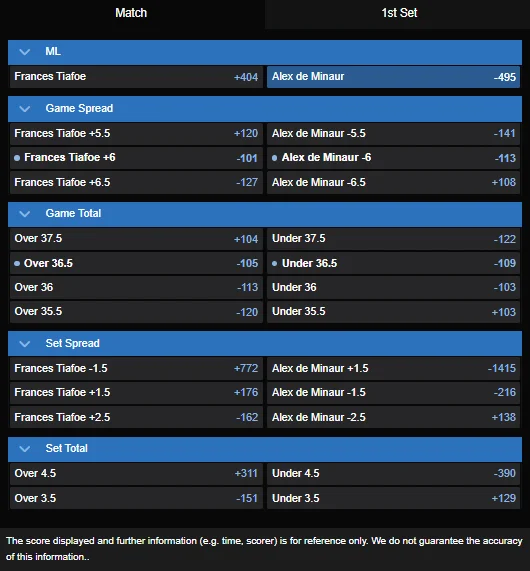
- Moneyline: De Minaur is priced as a heavy favorite, reflecting confidence in his defensive profile and best of five reliability. The market is clearly discounting Tiafoe’s variance driven upside.
- Game Spread: The spread suggests expectations of separation through breaks rather than tiebreak heavy sets. De Minaur’s return pressure underpins this pricing.
- Game Total: Totals in the mid to high 30s indicate a straight sets or efficient four set projection, aligned with de Minaur’s ability to shorten matches through defensive denial.
- Set Spread: De Minaur favored to cover a multi set margin reflects limited belief in Tiafoe sustaining pressure across multiple sets.
- Set Total: Under set totals are supported by de Minaur’s consistency and Tiafoe’s difficulty maintaining level across extended formats.
Final Prediction
This matchup is dictated by structure rather than ceiling. While Frances Tiafoe can produce highlight level tennis in isolated stretches, Alex de Minaur’s ability to neutralize pace and force repeated execution errors creates a low variance path to victory.
Unless Tiafoe sustains elite first serve performance and near flawless shot tolerance, de Minaur’s consistency and movement should gradually erode resistance.
For the Frances Tiafoe vs Alex de Minaur best odds, visit the best arbitrage sportsbook, where reduced juice can materially impact long term returns.
Bettor Summary
- Tiafoe path: Shorten points, dominate serve games, strike early.
- de Minaur path: Extend rallies, apply return pressure, force errors.
- Market lean: de Minaur moneyline and set spread.
- Live angle: If Tiafoe starts fast but fails to break, de Minaur in play prices may improve.
Disclaimer
This analysis uses AI assisted statistical research alongside human analysis and editorial oversight. Despite verification efforts, data errors may occur. Readers should independently verify odds, player stats, and records before betting. Projections are analytical estimates, not guarantees.