Alexander Zverev vs. Francisco Cerundolo Advanced Match Analysis – Australian Open 2026 Men’s Singles, 4th Round – Jan. 25, 2026
Australian Open 2026: Alexander Zverev vs Francisco Cerundolo Advanced Match Analysis
Event: Australian Open 2026 – Men’s Singles
Date: January 25th, 2026
Round: Fourth Round
Surface: Outdoor Hard
Location: Melbourne Park
Most Likely Outcome
Alexander Zverev in straight sets.
This fourth round matchup pairs a structurally complete hard court contender against a player whose strengths are more surface dependent and momentum driven. Alexander Zverev enters this stage of the tournament with a clear identity built around serve efficiency, baseline discipline, and physical durability over best of five. Francisco Cerundolo arrives after an impressive run, but the underlying matchup dynamics present a narrow margin for him to sustain pressure across multiple sets on a fast outdoor hard court.
The Australian Open environment places a premium on first serve reliability, return depth, and the ability to win neutral rallies without overextending. Zverev checks each of those boxes at a level Cerundolo has historically struggled to match on this surface. While Cerundolo is capable of competitive stretches and isolated momentum swings, the overall match structure favors Zverev controlling tempo and accumulating advantages steadily rather than explosively.
Matchup Snapshot
Zverev’s path in this matchup is straightforward and repeatable. He aims to establish serve dominance early, prevent Cerundolo from attacking second serves, and force rallies into patterns where depth and patience matter more than shot making flair. His height and reach allow him to serve wide and jam the body effectively, limiting Cerundolo’s ability to step into returns.
Cerundolo’s game thrives when he can dictate with heavy forehands, especially when given time to set his feet and work angles. On slower surfaces, this becomes a weapon that wears opponents down. On the Australian Open hard courts, those windows are shorter. Balls arrive faster, recovery time is limited, and neutral balls do not sit up long enough for consistent aggression.
The key contrast lies in rally tolerance. Zverev is comfortable extending exchanges without losing depth or balance. Cerundolo often needs to escalate pace to gain control. Over the course of a best of five match, that difference compounds, increasing error pressure on Cerundolo while allowing Zverev to remain structurally sound.
Emotionally, Zverev has shown improved composure in extended Grand Slam matches. Cerundolo, while competitive, has historically been more vulnerable to frustration when unable to impose his preferred patterns.
Player Comparison
| Player | Ranking | Age | Height | Plays | Backhand | Primary Style |
|---|---|---|---|---|---|---|
| Alexander Zverev | #6 | 28 | 6’6″ | Right | Two handed | Baseline controller with elite serve |
| Francisco Cerundolo | #22 | 27 | 6’1″ | Right | Two handed | Aggressive topspin baseliner |
Round 3 Performance Recap
Alexander Zverev
Zverev progressed through the third round with a performance that emphasized control rather than spectacle. His first serve percentage remained stable, allowing him to avoid prolonged service games. When rallies extended, he maintained depth through the middle of the court, preventing opponents from changing direction aggressively.
Defensively, Zverev showed improved lateral movement and patience. Rather than forcing early offense, he waited for errors and capitalized selectively. This approach conserved energy and reduced volatility, an important factor as matches lengthen.
Francisco Cerundolo
Cerundolo reached the fourth round by leaning into forehand aggression and willingness to dictate early in rallies. When timing was sharp, he was able to push opponents off the baseline and generate short balls to finish points.
However, his service games required sustained effort. Extended deuce games and reliance on forehand winners increased physical and mental load. Against a returner of Zverev’s caliber, that margin becomes more difficult to maintain.
Style and Attribute Breakdown
Alexander Zverev
Zverev’s game is built on structural efficiency. His serve is one of the most reliable on tour, particularly on hard courts, allowing him to control scorelines even when rallies are competitive. From the baseline, he uses height and reach to generate depth without excessive risk.
His backhand remains a stabilizing force, capable of absorbing pace and redirecting crosscourt exchanges. This limits Cerundolo’s ability to target one wing consistently.
Mentally, Zverev has shown growth in managing momentum. He no longer overreacts to missed opportunities and is comfortable resetting after long games.
Francisco Cerundolo
Cerundolo’s strengths are rooted in forehand weight and willingness to attack. His topspin forehand can push opponents back when given time, and his movement allows him to cover the court effectively in baseline exchanges.
The challenge lies in transition. When forced to defend or hit from compromised positions, his error rate increases. Against players who keep depth consistent, his offensive windows narrow.
Mentally, Cerundolo plays best when momentum favors him. Extended periods of neutral rallies can lead to frustration and rushed decisions.
Visual Matchup Profile
Attribute                 Zverev           Cerundolo
Serve Effectiveness       ██████████       ███████░░░
Return Pressure           ████████░░       ███████░░░
Baseline Control          █████████░       ███████░░░
Movement and Defense      ████████░░       ████████░░
Shot Tolerance            █████████░       ███████░░░
First Strike Ability      ███████░░░       █████████░
Serve and Return Dynamics
The serve return matchup heavily favors Zverev. His first serve consistently limits return aggression, and his second serve placement reduces attack opportunities. Cerundolo’s return game lacks the penetration needed to apply sustained pressure.
On the return side, Zverev’s depth neutralizes Cerundolo’s forehand setup. Even when Cerundolo gets the ball back in play, he often does so from defensive positions that prevent immediate offense.
Over multiple sets, this dynamic leads to fewer break opportunities for Cerundolo and increasing scoreboard pressure.
Surface and Conditions Analysis
The Melbourne hard courts reward clean ball striking, serve reliability, and balance under pressure. Players who rely on heavy topspin and extended preparation often find themselves rushed.
Zverev’s flatter strokes and compact swings translate efficiently in these conditions. Cerundolo does not receive the same surface assistance he enjoys on slower courts, where topspin has more time to work.
As the match progresses, physical recovery between points becomes critical. Zverev’s economy of movement provides a measurable edge.
Projected Match Flow
Cerundolo is likely to compete aggressively early, looking to establish forehand dominance and test Zverev’s movement. Early games may be competitive, particularly if Cerundolo finds first serve rhythm.
As returns accumulate and rallies extend, Zverev’s depth and patience should begin to erode Cerundolo’s confidence. Break opportunities are more likely to come through prolonged pressure rather than sudden swings.
The most probable flow involves one competitive set followed by Zverev gradually asserting control through reduced errors and superior serve efficiency.
Market Odds Snapshot
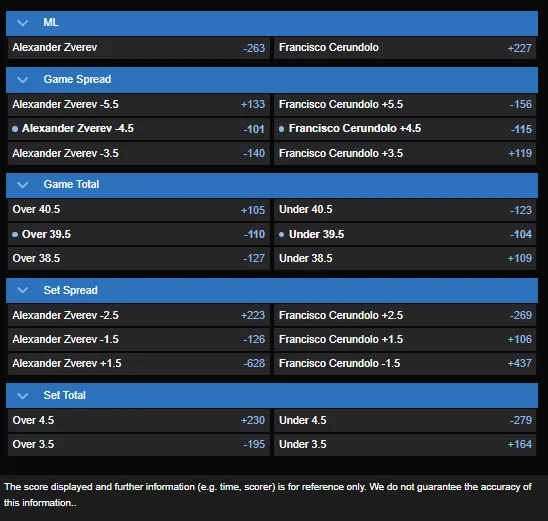
- Moneyline: Zverev favored reflects market confidence in his serve reliability and baseline stability over best of five, with Cerundolo’s clay oriented strengths viewed as less impactful on a fast hard court.
- Game Spread: Spreads around Zverev -3.5 to -4.5 suggest expectations of controlled separation rather than domination, implying Zverev breaks often enough but does not completely run away with sets.
- Game Total: Totals in the 38.5 to 40.5 range indicate the market expects competitive stretches, potentially one longer set, but not a prolonged five set battle.
- Set Spread: Zverev favored at -1.5 sets points toward a straight sets lean, while wider pricing on -2.5 shows limited confidence in a full sweep without resistance.
- Set Total: Under 3.5 priced shorter than Over reflects expectations that Zverev closes efficiently in three, with competitiveness expressed through games rather than sets.
Final Prediction
This matchup ultimately favors structure over flair. Cerundolo has the tools to compete in stretches, but sustaining aggression against a disciplined defender with elite serve reliability is a difficult task over best of five.
Zverev’s ability to control tempo, minimize volatility, and apply steady pressure provides the clearest path to a straight sets victory.
For the Alexander Zverev vs Francisco Cerundolo best odds, visit the best arbitrage sportsbook, where reduced juice can materially impact long term returns.
Bettor Summary
- Cerundolo path: Early forehand aggression, high first serve percentage, short points.
- Zverev path: Serve control, rally tolerance, error suppression.
- Match dynamic: Competitive early phase followed by structural separation.
- Live angle: If Cerundolo fails to convert early break chances, Zverev control increases sharply.
Disclaimer
This analysis uses AI assisted statistical research alongside human analysis and editorial oversight. Despite verification efforts, data errors may occur. Readers should independently verify odds, player stats, and records before betting. Projections are analytical estimates, not guarantees.