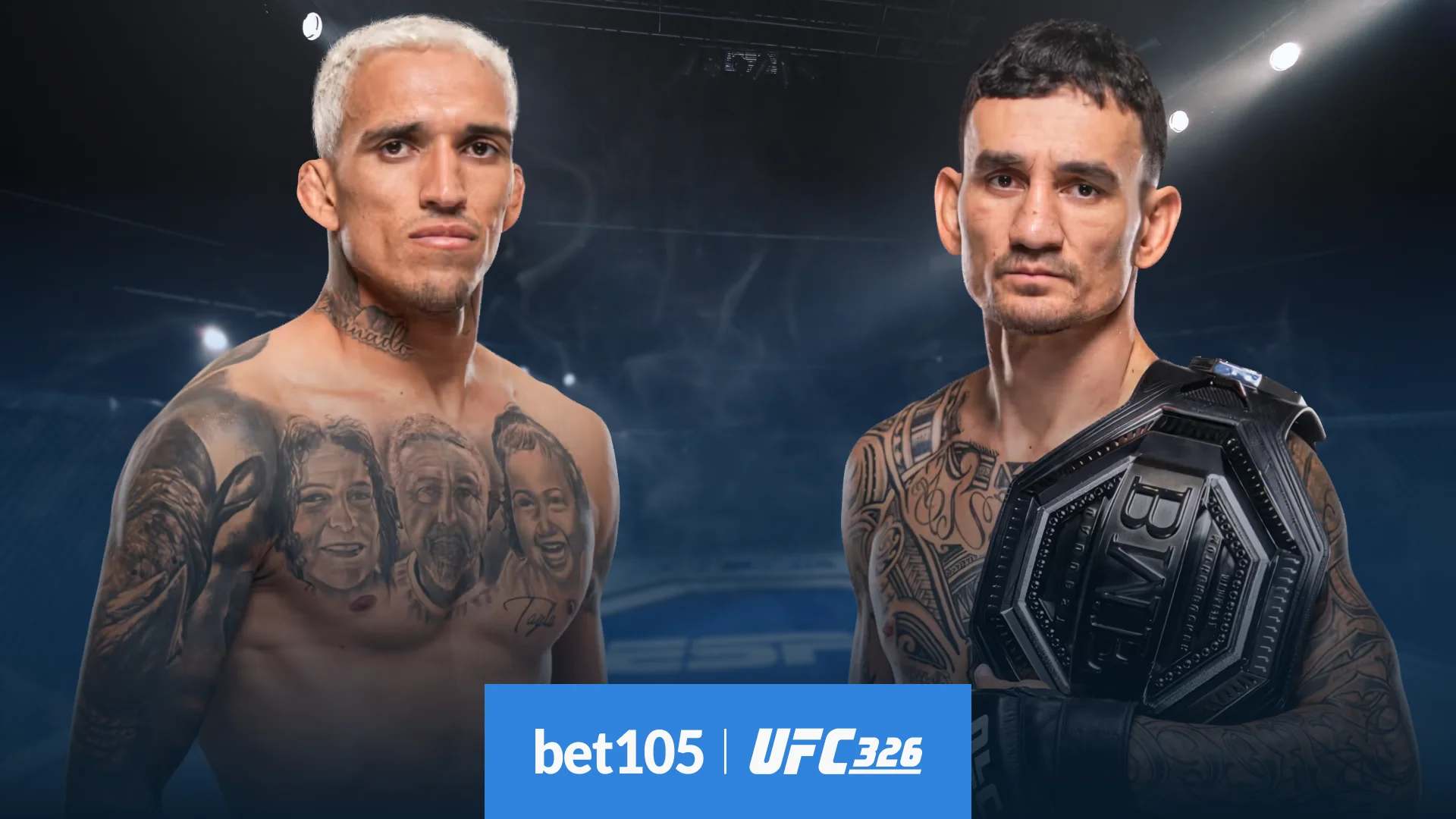
Max Holloway vs Charles Oliveira Advanced Fight Analysis UFC 326 Main Event
UFC 326 Main Event: Max Holloway vs Charles Oliveira – Advanced Fight Analysis
Event: UFC 326 Holloway vs Oliveira Main Event
Date: March 7, 2026 – 9pm ET
Location: T-Mobile Arena, Las Vegas, Nevada
Division: Lightweight (155 lbs)
Rounds: Five
Matchup Prediction: Max Holloway (-218) is the moneyline side. Charles Oliveira remains the most dangerous submission finisher in lightweight history, but over five rounds Holloway’s pace, durability, and defensive discipline create the wider win condition. Oliveira will have early submission windows, but Holloway’s volume and attritional pressure should take over as minutes accumulate. Pick: Max Holloway moneyline. Method: TKO. Round: Round 4.
1) Fighter Comparison Chart
| Fighter | Record | Height | Reach | Style Identity |
|---|---|---|---|---|
| Max Holloway | 26-8 | 5’11” | 69″ | High-volume pressure striker |
| Charles Oliveira | 34-10 | 5’10” | 74″ | Submission specialist with opportunistic striking |
This is a classic pace-versus-danger fight. Holloway overwhelms opponents with output, layering jabs, feints, and multi-strike combinations across extended stretches. Oliveira fights in high-leverage moments. He does not need volume. He needs transitions.
Over five rounds, the structural question becomes simple: can Oliveira force Holloway into grappling sequences early enough to avoid being drowned in cumulative damage?
2) Fighter Background and Form Trajectory
Max Holloway
Holloway is one of the most battle-tested strikers in UFC history. He has gone the distance in championship fights, five-round wars, and high-pace contests where durability and conditioning separate contenders from elite. His output often exceeds seven significant strikes per minute, but what makes him unique is how that pace escalates rather than declines.
Unlike many volume strikers, Holloway builds offense without reckless entries. His footwork allows him to strike while angling off the center line, minimizing clean counter exposure. Against grapplers, he historically defends initial entries well enough to return to striking range.
The five-round format strongly favors him. He has demonstrated the ability to maintain striking density into Rounds 4 and 5, where opponents typically slow.
Charles Oliveira
Oliveira holds the UFC record for submission wins and is one of the most opportunistic finishers in MMA history. His ability to capitalize on knockdowns, scrambles, and back takes is elite. He does not require dominant control time to end a fight.
His striking has improved dramatically over the years, especially in straight-line aggression and counter hooks. However, Oliveira’s defensive durability has fluctuated in prolonged exchanges. When opponents force him into sustained volume striking, vulnerabilities surface.
In five-round fights, Oliveira’s danger window is front-loaded. He is at his most lethal in Rounds 1 and 2, when explosion and submission urgency are highest.
3) Technical Striking Layer Breakdown
Holloway’s primary weapons are jab volume, stance switching, and layered combinations to head and body. He rarely throws isolated single shots. Instead, he builds sequences of three to five strikes that accumulate damage.
Oliveira, by contrast, uses forward pressure combined with opportunistic counters. His straight right and left hook combinations can stun opponents who overextend. He also uses kicks to close distance before level changes.
Over extended minutes, Holloway’s strike count will likely double Oliveira’s output. The key question is not whether Holloway lands more. It is whether Oliveira can land more consequential shots early.
4) Grappling Phase Analysis
Oliveira’s grappling is elite in transitional chaos. He excels in scrambles, back takes, and armbar entries when opponents make small defensive mistakes.
Holloway’s takedown defense historically sits near the 80 percent range. More importantly, his scrambling awareness prevents extended control time. He may concede brief positions but rarely allows sustained dominance.
In five rounds, even a single successful submission attempt could shift momentum dramatically. However, Holloway’s discipline in maintaining posture during clinch exchanges reduces exposure.
5) Cardio and Pace Escalation Modeling
Over five rounds, cardio becomes a weapon. Holloway historically increases pace in Rounds 3 through 5. His strike output tends to rise as opponents fatigue.
Oliveira’s explosiveness is highest in the first ten minutes. While he has gone long distances before, his finishing probability declines noticeably as fights extend.
If Holloway forces Oliveira to defend prolonged combinations and wrestle repeatedly, the cumulative fatigue effect becomes significant entering championship rounds.
6) Durability and Damage Tolerance
Holloway has absorbed high-level power across multiple divisions without sustained knockout damage. His chin remains one of his most reliable assets.
Oliveira has shown resilience but has also been stopped multiple times in his career. Extended striking exchanges without grappling success increase risk exposure for him.
Durability over five rounds heavily favors Holloway.
7) Round-by-Round Probability Tree
Round 1: Highest submission risk window for Oliveira. Holloway likely probes with jab volume.
Round 2: If Oliveira has not secured control, Holloway’s pressure begins increasing.
Round 3: Fight tempo tilts toward Holloway if striking remains primary phase.
Rounds 4–5: Holloway’s cumulative damage and conditioning edge become decisive.
8) Betting Market Interpretation
Holloway at -218 implies roughly 68 percent win probability. Oliveira at +183 implies roughly 35 percent.
The total of 2.5 rounds with Over at -166 signals expectation of extended action. Books anticipate Oliveira surviving early exchanges or Holloway taking time to break him down.
9) Implied Probability Table
| Market | Odds | Implied Probability |
|---|---|---|
| Max Holloway | -218 | ~68.5% |
| Charles Oliveira | +183 | ~35.3% |
10) Simulation Projection
Model projection:
- Holloway win probability: 66%
- Oliveira win probability: 34%
- Inside distance probability: 62%
- Submission probability (Oliveira): 22%
If Holloway survives the first two rounds without extended grappling damage, his probability rises above 75 percent entering Round 3.
11) Expected Value Layer
Holloway’s price aligns closely with projected probability. There is no large market inefficiency on the moneyline.
Oliveira’s value exists only if one believes his early submission probability exceeds roughly 30 percent.
Derivative markets such as Holloway by TKO in Rounds 3–5 may offer stronger structural alignment with fight shape.
12) Market Odds Snapshot
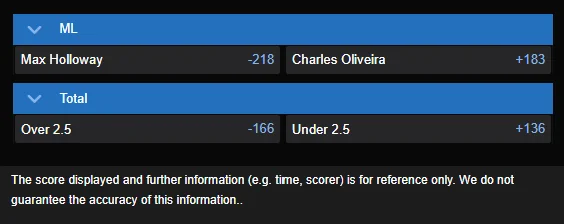
- Moneyline: Max Holloway (-218) enters as the favorite, implying roughly a 68–69% win probability. The market is pricing Holloway’s pace, durability, and five-round cardio advantage as the more reliable path, while Charles Oliveira (+183) remains a dangerous underdog whose best leverage comes from early knockdowns or submission opportunities during chaotic exchanges.
- Total (2.5 Rounds): The total is lined with Over 2.5 (-166) and Under 2.5 (+136), indicating the market expects the fight to extend beyond the early submission window. The over lean reflects Holloway’s durability and Oliveira’s tendency to survive early exchanges before momentum shifts later in the fight.
13) Recommended Bets
- Primary: Max Holloway moneyline
- Lean: Over 2.5 rounds
- High variance angle: Oliveira by submission (Rounds 1–2)
- Alternative angle: Holloway TKO Rounds 3–5
14) Bettor’s Summary
This main event is defined by time. Charles Oliveira is most dangerous early, particularly in chaotic grappling exchanges. Max Holloway becomes more dangerous with every passing minute.
If Holloway avoids early submission traps and maintains disciplined distance striking, his volume and cardio should overwhelm Oliveira in championship rounds. The most likely outcome is Holloway securing a late stoppage after sustained attritional damage.
Five-round modeling favors durability, output, and sustainability. All three categories lean Holloway.
Disclaimer
This analysis uses AI-assisted statistical research alongside human analysis and editorial oversight. Despite verification efforts, data errors may occur. Readers should independently verify odds, fighter stats, and records before betting. Projections are analytical estimates, not guarantees.