Alexander Zverev vs. Learner Tien Australian Open Men’s Singles Quarterfinals Jan. 26, 2026
Australian Open 2026: Alexander Zverev vs Learner Tien Advanced Match Analysis
Event: Australian Open 2026 – Men’s Singles
Date: January 26th, 2026
Round: Quarterfinals
Surface: Outdoor Hard
Location: Melbourne Park
Most Likely Outcome
Alexander Zverev in straight sets.
This quarterfinal matchup pairs one of the most established hard court performers of the last decade against one of the tournament’s most unexpected breakout stories. Alexander Zverev enters the Australian Open quarterfinals with a clear identity built on serve dominance, baseline stability, and years of experience navigating the physical and mental demands of deep Grand Slam runs. Learner Tien, by contrast, arrives as a rising talent whose composure and tactical maturity have exceeded expectations throughout the opening rounds.
While Tien’s run deserves recognition, the structural demands of a Grand Slam quarterfinal introduce a level of pressure, repetition, and physical stress that few teenagers are equipped to manage against elite opposition. On Melbourne’s hard courts, where serve quality and rally depth consistently dictate outcomes, the matchup strongly favors the player capable of controlling tempo without unnecessary risk. That profile aligns decisively with Zverev.
The most likely scenario involves competitive passages early in sets, followed by gradual separation as Zverev’s serve efficiency and baseline weight begin to erode Tien’s defensive margins.
Matchup Snapshot
Zverev’s path to victory is built on structural superiority rather than explosive aggression. His first serve remains one of the most reliable weapons left in the draw, allowing him to hold service games with minimal exposure to extended rallies. This places constant scoreboard pressure on opponents, forcing them to defend their own service games with little margin for error.
From the baseline, Zverev excels at controlling depth. He rarely overcommits to low percentage winners, instead using heavy topspin and flat backhand drives to keep opponents pinned behind the baseline. This approach is particularly effective against players who rely on timing rather than raw power.
Tien’s strengths are more subtle. He reads the ball exceptionally well, moves efficiently, and maintains composure even during extended rallies. His ability to stay mentally present under pressure has been a defining feature of his tournament run.
However, the key question is sustainability. Against elite defenders with superior serve protection, Tien must repeatedly defend under pressure while also finding ways to shorten points. Over the course of a best of five match, that task becomes exponentially more difficult.
Player Comparison
| Player | Ranking | Age | Height | Plays | Backhand | Primary Style |
|---|---|---|---|---|---|---|
| Alexander Zverev | #4 | 28 | 6’6″ | Right | Two handed | Power baseliner with elite serve stability |
| Learner Tien | #73 | 19 | 5’11” | Left | Two handed | Counterpuncher with early timing |
Round 4 Performance Recap
Alexander Zverev
Zverev’s fourth round performance was emblematic of his tournament approach. He prioritized efficiency, limiting unnecessary exchanges while protecting his serve with precision. His first serve percentage remained stable throughout the match, allowing him to dictate service games without expending excess energy.
On return, Zverev demonstrated patience rather than urgency. Rather than chasing early breaks, he focused on applying depth and pressure to second serves, trusting that opportunities would emerge organically. This restraint reflects maturity developed through multiple deep Grand Slam campaigns.
Physically, Zverev appeared comfortable, moving fluidly across the baseline and showing no signs of fatigue despite the increasing demands of the tournament schedule.
Learner Tien
Tien’s path to the quarterfinals has been defined by composure and tactical clarity. In the fourth round, he navigated pressure moments with notable calm, particularly during extended baseline exchanges. His shot selection remained disciplined, avoiding reckless aggression.
However, service games frequently required extended effort. Second serves were attacked consistently, and Tien was forced to defend deep court positions for prolonged periods. While he managed these moments admirably, the cumulative physical and mental cost was evident.
Against a player with Zverev’s serve efficiency, those patterns become significantly harder to manage.
Style and Attribute Breakdown
Alexander Zverev
Zverev’s game thrives on predictability and control. His serve establishes immediate authority, often producing free points or weak returns that allow him to dictate the next shot. When rallies develop, he relies on depth rather than outright pace to wear opponents down.
His backhand remains one of the most consistent shots in men’s tennis, capable of absorbing pace while maintaining directional control. This reliability allows Zverev to engage in extended rallies without exposing himself to unnecessary risk.
Mentally, Zverev has shown improved patience in recent seasons. He no longer chases quick breaks, instead trusting his ability to sustain pressure over time. This evolution has been critical to his success in best of five matches.
Learner Tien
Tien’s game is built around timing, anticipation, and movement. He excels at redirecting pace and forcing opponents to hit additional shots. His court sense allows him to stay competitive even when physically outmatched.
The challenge lies in offensive production. Against elite defenders, generating winners requires near perfect execution. Tien’s serve, while improving, does not yet offer consistent relief against top tier returners.
As matches extend, the physical demands of defending deep positions become increasingly taxing, particularly against opponents capable of sustaining heavy pace.
Visual Matchup Profile
Attribute                 Zverev          Tien
Serve Effectiveness       ██████████       ██████░░░░
Return Pressure           ████████░░       ██████░░░░
Baseline Power            █████████░       ██████░░░░
Movement and Defense      ████████░░       ████████░░
Shot Tolerance            █████████░       ███████░░░
Experience Under Pressure ██████████       ██████░░░░
Serve and Return Dynamics
Zverev’s serve is the most decisive weapon in this matchup. His ability to consistently hit spots and vary pace prevents opponents from establishing rhythm on return. This not only secures service holds but also conserves energy across long matches.
On return, Zverev applies pressure through depth rather than outright aggression. His positioning allows him to neutralize second serves and immediately push opponents into defensive positions.
Tien must maintain a high first serve percentage to avoid being drawn into repeated baseline exchanges. Any lapse in serve quality invites sustained pressure that favors Zverev.
Surface and Conditions Analysis
Melbourne’s hard courts reward players who can combine serve efficiency with controlled aggression. Zverev’s height and reach allow him to dictate points from above the net, while his movement has adapted well to the surface.
Tien benefits from the true bounce and predictable conditions, but the surface does little to mask limitations in serve potency against elite opponents.
As the tournament progresses, recovery time shortens and physical durability becomes a critical factor. Zverev’s experience managing five set matches provides a clear advantage in this context.
Projected Match Flow
Early in the match, Tien is likely to remain competitive through timing and defensive discipline. Initial games may stay close as both players establish rhythm.
As the match unfolds, Zverev’s serve protection and baseline depth should begin to create separation. Break opportunities are most likely to emerge through extended pressure rather than sudden momentum shifts.
The most probable flow involves competitive early sets followed by increasing control from Zverev as physical and tactical advantages accumulate.
Market Odds Snapshot
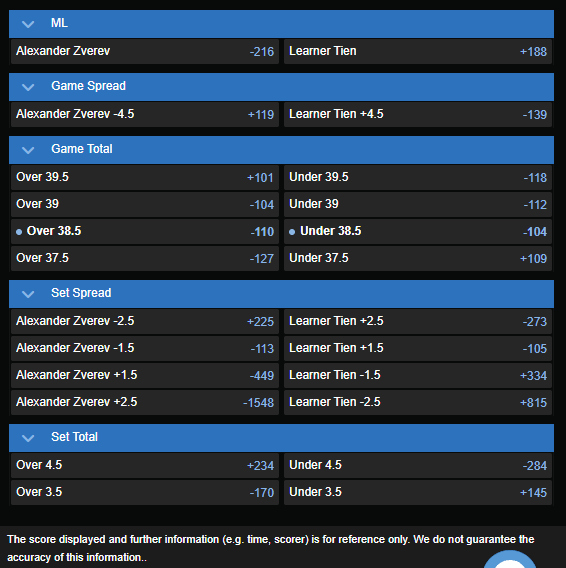
- Moneyline: Zverev favored reflects market confidence in his serve stability, physical durability, and Grand Slam experience.
- Game Spread: Lines around Zverev -4 to -4.5 suggest expectations of controlled separation rather than dominance.
- Game Total: Totals in the 37.5 to 39.5 range imply competitive passages without a prolonged five set battle.
- Set Spread: Zverev -1.5 indicates a straight sets lean while acknowledging Tien’s ability to compete within sets.
- Set Total: Under 3.5 favored reflects expectations of efficiency over volatility.
Final Prediction
Learner Tien’s tournament run has been impressive and highlights a promising future. However, this quarterfinal represents a significant escalation in difficulty. Zverev’s serve efficiency, baseline depth, and experience provide decisive advantages across all phases of the match.
Unless Tien can sustain extraordinary serving efficiency and consistently shorten rallies, the structural pressure applied by Zverev is likely to accumulate steadily.
For the Alexander Zverev vs Learner Tien best odds, visit the best arbitrage sportsbook, where reduced juice can materially impact long term returns.
Bettor Summary
- Tien path: High first serve percentage, early aggression, short points.
- Zverev path: Protect serve, extend rallies, apply sustained return pressure.
- Match dynamic: Competitive early before gradual separation.
- Live angle: Breaks gained through accumulation rather than bursts.
Disclaimer
This analysis uses AI assisted statistical research alongside human analysis and editorial oversight. Despite verification efforts, data errors may occur. Readers should independently verify odds, player stats, and records before betting. Projections are analytical estimates, not guarantees.