Carlos Alcaraz vs Yannick Hanfmann Advanced Match Analysis – Men’s Australian Open 2nd Round
Australian Open 2026: Carlos Alcaraz vs Yannick Hanfmann Advanced Match Analysis
Event: Australian Open 2026 – Men’s Singles
Date: January 20th, 2026
Round: Second Round
Surface: Outdoor Hard
Location: Melbourne Park
—
Most Likely Outcome:
🔥Alcaraz absorbs early resistance but takes control, winning in straight sets or four sets.
Matchup Snapshot
| Attribute | Carlos Alcaraz | Yannick Hanfmann |
|---|---|---|
| ATP ranking | 2 | 102 |
| Age | 22 | 33 |
| Primary strengths | Movement, return depth, rally control | Serve, first strike forehand |
| Five set reliability | Very high | Limited |
| Main vulnerability | Occasional impatience | Extended rallies and fatigue |
At a glance, this matchup is defined by how each player sustains pressure. Alcaraz is built to handle long matches where points repeat and physical demands accumulate. Hanfmann is built to take advantage early, shorten exchanges, and avoid being drawn into prolonged baseline battles.
—
Matchup Profile
This match becomes easier to understand once you strip it down to how each player prefers to win points.
Carlos Alcaraz is comfortable letting points develop. He does not need to dictate immediately, and he rarely looks rushed even when put on defense. His movement allows him to recover quickly, and his shot selection gives him enough margin to stay consistent without losing aggression. Over time, this combination tends to wear opponents down rather than overwhelm them all at once.
Yannick Hanfmann plays a much narrower game. His best tennis comes when he can lean heavily on his serve, step into the next ball, and finish points early. When that rhythm is there, he can look dangerous and confident. When it is not, his options become limited, especially against players who can return serve with depth and consistency.
The tension in this matchup comes from whether Hanfmann can keep the match in that narrow window long enough to matter. Against many players, that is possible. Against Alcaraz, it becomes increasingly difficult the longer the match goes on.
—
Player Context and Tournament Expectations
Carlos Alcaraz arrives at the Australian Open with expectations that go well beyond simply advancing through the early rounds. As a top seed and a player who has already proven he can handle the physical and mental demands of Grand Slam tennis, his focus is on conserving energy, sharpening patterns, and avoiding unnecessary complications. Matches like this are about control rather than survival.
That mindset matters. Alcaraz does not need to chase the match early, and he does not need to make statements with every point. He can afford to stay patient, trust his game, and let the match come to him.
Hanfmann enters this tournament from a very different position. For players ranked outside the top one hundred, early rounds at a Slam often represent the best chance to make a mark, earn points, and generate momentum. That urgency can be both a strength and a weakness. It can sharpen focus early, but it can also push players into pressing when things stop going smoothly.
Historically, players in Hanfmann’s position tend to have their best chances early in matches against top opponents. If those chances are not converted, the match often slips away quietly rather than dramatically. This context helps explain why early scorelines in matches like this can sometimes be misleading.
—
Australian Open Conditions and Physical Demands
The Australian Open places a specific kind of stress on players, particularly in the early rounds. Matches are played in warm conditions, recovery time between points matters, and lateral movement is tested repeatedly. Players who rely on quick points can thrive briefly, but sustaining that approach over several sets becomes challenging.
Alcaraz is well suited to these demands. His movement is efficient rather than explosive, which allows him to stay balanced even as rallies extend. He recovers quickly between points and does not need to shorten exchanges to protect his legs. This gives him flexibility in how he approaches the match.
Hanfmann’s game is more sensitive to these conditions. His serve is most effective when his legs are fresh and his timing is precise. As service games become longer and rallies extend, the physical cost of holding serve increases. Even when he holds, it often requires more effort, which adds up over time.
This does not mean the conditions decide the match on their own. They simply make it harder for Hanfmann to maintain the level he needs across multiple sets.
—
Serve and Return Dynamics
Hanfmann Serving Patterns
Hanfmann’s serve is the engine of his game. When it is landing consistently, he can open the court, dictate the next shot, and keep points short. His confidence rises quickly when service games are straightforward, and that confidence can carry into his groundstrokes.
The issue is how dependent he is on maintaining that level. His first serve percentage needs to stay high for him to hold comfortably. When it drops, even slightly, his second serve becomes vulnerable. It tends to sit in a range that allows strong returners to get the ball back deep and start rallies without much risk.
Against players who struggle to return with depth, this vulnerability is manageable. Against Alcaraz, it becomes a recurring problem. Service games that look safe on paper turn into extended battles, and those battles take a toll.
Alcaraz Returning Patterns
Alcaraz approaches returns with patience and discipline. He is not looking to end points on the return. His goal is to neutralize the serve, get the ball back deep, and force the point to develop.
This approach pays dividends over time. Even when he does not break immediately, he increases the physical and mental load on the server. Longer service games lead to more second serves, more rallies, and eventually more mistakes.
The key difference is efficiency. Alcaraz applies pressure without spending much energy himself, which allows him to maintain the same level deep into the match.
—
Rally Length and Point Construction
Once rallies extend beyond the opening exchange, the balance shifts clearly in Alcaraz’s favor.
Alcaraz is comfortable playing long points. His footwork allows him to stay balanced even when pulled wide, and his forehand remains reliable under pressure. He does not rush to finish points and is willing to reset rallies if the opening is not there.
Hanfmann can win long rallies occasionally, but he cannot rely on them. As rallies extend, his depth becomes harder to maintain, particularly on the backhand side. His court position drifts backward, which gives Alcaraz more time and space to dictate.
These changes are often subtle. They do not show up as dramatic errors at first. They show up as slightly shorter balls, missed opportunities to attack, and an increasing need to go for lower percentage shots. Over the course of a set, those small disadvantages add up.
—
Tactical Responsibilities
What Alcaraz Needs to Execute
Alcaraz’s path in this match is straightforward. He needs to return serve with depth, avoid giving away cheap points, and stay disciplined in rallies. He does not need to force the issue early, and he does not need to chase winners from difficult positions.
Targeting Hanfmann’s backhand in crosscourt exchanges helps lengthen points and test consistency. Changing direction selectively prevents Hanfmann from settling into rhythm without increasing risk. Drop shots can be effective when used sparingly, especially to pull Hanfmann forward and disrupt his positioning.
Above all, Alcaraz needs to stay patient. This is a match that rewards steadiness more than brilliance.
What Hanfmann Needs to Execute
Hanfmann’s requirements are more demanding. He needs his first serve to remain effective, and he needs to follow it up with confident first strikes. Shortening points is essential, as extended rallies favor Alcaraz.
He also needs to manage frustration. As return games get longer and rallies extend, it becomes tempting to press for quick points. That pressure often leads to errors rather than relief.
—
How the Match Tends to Develop
Matches like this often start with a sense of balance that fades gradually rather than abruptly.
In the opening set, Hanfmann is most capable of holding serve efficiently and keeping things close. His legs are fresh, his serve is lively, and Alcaraz is still settling into the match. Tight games and even a tiebreak are possible in this phase.
As the match progresses, service games lengthen, returns land deeper, and rallies extend. Alcaraz begins to apply pressure without noticeably raising his level. Hanfmann, meanwhile, has to work harder just to stay even.
Once Alcaraz secures a break and holds comfortably, the dynamic shifts. Hanfmann is forced to take more risks, which increases his error rate and accelerates separation rather than reversing it.
—
Match Progression Over Time
| Stage | Typical pattern |
|---|---|
| Early phase | Hanfmann holds serve well, points stay short |
| Middle phase | Returns deepen, rallies extend, pressure builds |
| Later phase | Movement and consistency create clear separation |
As the match moves from one phase to the next, the advantage increasingly favors the player who is comfortable staying in rallies.
—
Market Analysis
Match Winner 🔥🔥🔥
From a matchup perspective, this is a clear favorite situation. Alcaraz does not need exceptional conditions or mistakes from his opponent to win. He simply needs to play within himself and let the match develop.
The main consideration from a betting standpoint is price. Discipline matters if the number stretches too far, but the underlying matchup is not particularly ambiguous.
Set Betting 🔥🔥
The more interesting question is how competitive any individual set truly is.
A close set built on quick holds and efficient serving can signal genuine resistance. A close set built on repeated break points and long service games often signals the opposite, because it usually leaves Hanfmann more fatigued than encouraged.
Understanding how a set is played matters more than the score itself.
Total Games 🔥
Totals are heavily influenced by the opening phase. Clean holds early push totals higher, while early breaks pull them down. As the match settles into longer rallies and repeated pressure, totals tend to compress.
Live observation tends to be more useful than pre match assumptions in this spot.
—
Final Assessment
Carlos Alcaraz holds clear advantages in movement, rally tolerance, and return quality. He does not need to play spectacular tennis to control this match. He needs to stay patient and let the physical and tactical demands do their work.
Yannick Hanfmann can compete early if his serve holds up and points stay short. Sustaining that approach over multiple sets, particularly in Melbourne conditions, is difficult.
Market Odds Snapshot (bet105)
At the time of writing, bet105 is offering the following primary markets for this matchup:
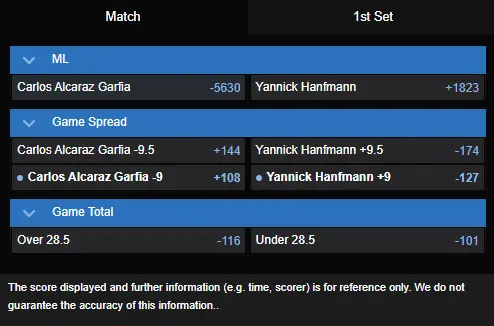
These numbers reflect a market that expects control rather than drama. The moneyline pricing is effectively unplayable on its own, which shifts attention toward spreads and totals where match flow and efficiency matter more than outright outcome.
This is consistent with how matches of this profile are usually priced. The favorite is expected to win comfortably, but the question becomes how cleanly that control is expressed across sets.
bet105 Perspective
For bettors looking to approach this match through bet105, the focus should not be on whether Carlos Alcaraz wins, but on how the match unfolds across its phases.
Heavy moneyline pricing reflects the structural gap between these players. Value, if it exists, comes from understanding whether early resistance meaningfully extends the match or simply delays the inevitable.
Game spreads tell a clearer story. A number in the nine game range suggests the market expects Alcaraz to separate over time rather than immediately. That aligns with the matchup dynamics, where Hanfmann can remain competitive early before return pressure and rally length begin to tilt sets more decisively.
Totals sit near a range that assumes at least one competitive set. Whether that assumption holds depends on how efficiently Hanfmann holds serve early, not simply whether sets stay close on the scoreboard.
—
For the best odds on Alcaraz vs. Hanfmann at the Australian Open 2026, visit bet105, the top arbitrage sportsbook with reduced juice, fast crypto payouts, and sharp friendly limits.
Disclaimer
This analysis uses AI assisted statistical research alongside human analysis and editorial oversight. Despite verification efforts, data errors may occur. Readers should independently verify odds, player stats, and match details before betting. This content is analytical in nature and does not guarantee outcomes.