Tomas Machac vs. Stefanos Tsitsipas Advanced Match Analysis – Australian Open 2026 Men’s Singles, 2nd Round – Jan. 20, 2026

Australian Open 2026: Tomas Machac vs Stefanos Tsitsipas Advanced Match Analysis
Event: Australian Open 2026 – Men’s Singles
Date: January 20th, 2026
Round: Second Round
Surface: Outdoor Hard
Location: Melbourne Park
Most Likely Outcome
Tomas Machac in four sets. This reflects a scenario where Machac’s superior court coverage, backhand stability, and rally tolerance gradually expose Stefanos Tsitsipas’ defensive liabilities and inconsistent backhand wing, even if Tsitsipas’ serve and forehand firepower allow him to claim a set and create intermittent momentum.
Matchup Snapshot
This second-round Australian Open matchup stands out as one of the most structurally fascinating contests on the board. Tomas Machac enters as a slight favorite, a reality that would have seemed improbable in prior seasons but now reflects a meaningful shift in form, matchup dynamics, and baseline reliability. Stefanos Tsitsipas, once a perennial title contender, finds himself priced as an underdog against a player whose game is built specifically to expose the weaknesses that have increasingly defined Tsitsipas’ struggles.
The betting market captures this tension clearly. Machac’s position as favorite reflects confidence in his defensive integrity, lateral speed, and ability to sustain pressure over extended rallies. Tsitsipas’ underdog price, meanwhile, is less an indictment of his talent than an acknowledgment of his volatility, particularly on hard courts against elite movers who can neutralize his forehand and relentlessly target his backhand side.
This match is not about raw upside. Tsitsipas still possesses the higher peak, especially when his serve and forehand are clicking. Instead, the matchup centers on sustainability. Over best-of-five sets, Machac’s ability to absorb pace, redirect from both wings, and force repeated defensive sequences gives him a structurally sound path to victory.
Player Comparison
| Player | Ranking | Record (YTD) | Career Record | Age | Height | Plays | Backhand |
|---|---|---|---|---|---|---|---|
| Tomas Machac | Top 30 | 6–2 | 142–98 | 25 | 6’1″ | Right | Two Handed |
| Stefanos Tsitsipas | Top 15 | 4–4 | 346–185 | 27 | 6’4″ | Right | One Handed |
Style and Attribute Profile
Tomas Machac
Machac’s game is built on balance, elasticity, and point construction discipline. He does not rely on a single overwhelming weapon, but instead applies consistent pressure through depth, pace absorption, and directional control. His two-handed backhand is a particular strength, capable of handling heavy topspin while redirecting pace down the line with confidence.
From the baseline, Machac excels at neutralizing first-strike attackers. He moves exceptionally well laterally, allowing him to defend wide forehands and reset points without losing court position. This skill becomes especially valuable against players like Tsitsipas, whose offensive game depends heavily on dictating with the forehand from inside the court.
Machac’s serve is solid rather than spectacular, but his placement and willingness to vary spin help him avoid predictable patterns. More importantly, his second serve is reliable enough to prevent opponents from consistently attacking early.
Stefanos Tsitsipas
Tsitsipas remains one of the tour’s most naturally gifted offensive players. His forehand, when functioning at peak confidence, is a devastating weapon capable of ending points from nearly any position. His serve, particularly on the ad side, can still generate free points against even strong returners.
However, Tsitsipas’ one-handed backhand continues to be a structural vulnerability, particularly on hard courts. Under sustained pressure, the wing can break down, producing short balls that invite attack or unforced errors when rushed.
Defensively, Tsitsipas struggles more than most elite players when forced into extended lateral movement. His recovery speed is adequate but not elite, making him susceptible to opponents who can repeatedly redirect pace.
Player Backgrounds
Tomas Machac
Machac has quietly developed into one of the most reliable baseline competitors on hard courts. His progression has been defined by incremental improvement rather than breakout moments, resulting in a game that is now well-suited for best-of-five tennis.
At Grand Slam events, Machac’s conditioning and mental steadiness have allowed him to compete effectively against higher-ranked opponents. He does not panic when matches extend, nor does he abandon structure in pursuit of quick winners.
Bettor takeaway: Machac’s floor is high, and his style scales well as match length increases.
Stefanos Tsitsipas
Tsitsipas enters this tournament at a crossroads. While still ranked among the elite, his results have become increasingly inconsistent, particularly against disciplined baseliners who refuse to offer forehand dominance cheaply.
At the Australian Open, Tsitsipas has historically found success when his serve and forehand rhythm are established early. When forced to grind without immediate rewards, frustration can creep into his decision-making.
Bettor takeaway: Tsitsipas remains dangerous, but his margin for error is thinner than his ranking suggests.
Serve and Return Dynamics
The serve-return dynamic is central to this matchup’s volatility. Tsitsipas will look to shorten points aggressively behind his first serve, using wide placements to open forehand space. When successful, he can hold serve efficiently and keep pressure on Machac.
Machac, however, is well-equipped to handle this pattern. His return positioning emphasizes depth and central control, forcing Tsitsipas to hit additional balls rather than finish immediately.
On Machac’s serve, Tsitsipas may attempt to attack second serves with his forehand, but this strategy carries risk. Overextension can lead to errors and momentum swings.
Surface and Conditions Analysis
Melbourne’s outdoor hard courts reward athletic defense and consistency as much as power. The surface plays true, allowing Machac’s redirection skills to shine while exposing Tsitsipas’ backhand under sustained pressure.
Long rallies are more physically taxing here than on slower hard courts, increasing the importance of movement efficiency and recovery. This subtly favors Machac over the course of a four- or five-set match.
Match Flow and Tactical Dynamics
Early in the match, Tsitsipas is likely to assert himself through aggressive serving and forehand dominance. A fast start could see him claim an opening set if Machac requires time to settle.
As the match progresses, Machac’s patience and defensive resilience are expected to shift momentum. Longer rallies and repeated targeting of the backhand wing can gradually erode Tsitsipas’ confidence.
If the match extends beyond three sets, the balance increasingly tilts toward Machac, whose game does not rely on sustained offensive perfection.
Market Odds Snapshot
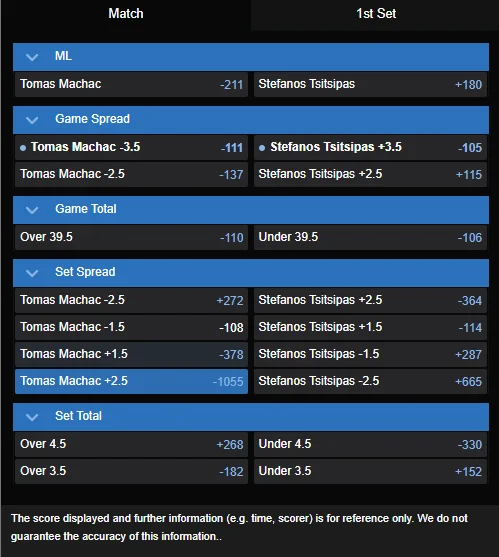
- Moneyline: Machac’s favorite status reflects confidence in his rally tolerance and defensive matchups against Tsitsipas’ known vulnerabilities.
- Game Spread: Narrow spreads indicate expectations of competitive sets rather than a lopsided result.
- Game Total: Totals near 40 games suggest a strong likelihood of four sets, with potential for extended games.
- Set Spread: Pricing implies that Tsitsipas is expected to take at least one set, even if Machac controls the match overall.
- Set Total: Markets lean toward over, reinforcing expectations of a four-set or longer contest.
Final Prediction
This matchup represents a difficult stylistic challenge for Stefanos Tsitsipas. While his serve and forehand can still dictate stretches of play, Tomas Machac’s defensive integrity and consistency provide a more sustainable path over best-of-five.
Expect momentum swings, particularly early, but Machac’s ability to absorb pressure and extend rallies should ultimately prevail.
Prediction: Tomas Machac defeats Stefanos Tsitsipas in four sets.
Method Confidence: 56%
Overall Confidence: 59%
For the Tomas Machac vs Stefanos Tsitsipas best odds, visit bet105, the top arbitrage sportsbook with reduced juice, fast crypto payouts and sharp friendly limits.
Bettor Summary
- Machac path: Extended rallies and backhand pressure.
- Tsitsipas path: Serve-plus-forehand efficiency.
- Match length bias: Long.
- Live angles: Tsitsipas backhand error rate under pressure.
Disclaimer
This analysis uses AI assisted statistical research alongside human analysis and editorial oversight. Despite verification efforts, data errors may occur. Readers should independently verify odds, player stats, and records before betting. Projections are analytical estimates, not guarantees.