Alexander Bublik vs. Tomas Etcheverry Advanced Match Analysis – Australian Open 2026 Men’s Singles, 3rd Round – Jan. 23, 2026

Australian Open 2026: Alexander Bublik vs Tomas Martin Etcheverry Advanced Match Analysis
Event: Australian Open 2026 – Men’s Singles
Date: January 23rd, 2026
Round: Third Round
Surface: Outdoor Hard
Location: Melbourne Park
Most Likely Outcome
Alexander Bublik in four sets.
This matchup presents a contrast between creativity and control versus structure and endurance. Alexander Bublik’s serve and shot variety give him the ability to dictate large portions of the match, particularly on faster hard courts. Tomas Martin Etcheverry brings consistency and physical resilience, but over a best of five format in Melbourne, the surface and conditions amplify Bublik’s strengths more than Etcheverry’s.
Matchup Snapshot
At a structural level, this match is defined by who controls point length. Alexander Bublik is at his best when points remain short and unpredictable. His serve is a constant threat to produce free points or weak returns, and his willingness to change pace, spin, and placement keeps opponents from settling into rhythm.
Tomas Martin Etcheverry operates from the opposite end of the spectrum. He is a methodical baseline player who relies on rally tolerance, depth, and physical consistency. His game thrives when he can establish long exchanges and wait for errors rather than force winners.
The Australian Open hard courts tilt this balance. The surface rewards serve quality and early strike tennis, especially under daytime conditions where bounce is true and pace carries through the court. Bublik’s ability to take control of service games puts immediate pressure on Etcheverry, who must work significantly harder to hold serve.
Over a best of five format, Etcheverry’s margin becomes narrow. He needs sustained success in long rallies while also navigating frequent pressure on his own service games. Bublik, by contrast, can win matches through shorter point sequences, conserving energy even when dropping a set.
Player Comparison
| Player | Ranking | Age | Height | Plays | Backhand | Primary Style |
|---|---|---|---|---|---|---|
| Alexander Bublik | #21 | 28 | 6’5″ | Right | Two handed | Serve first aggressor |
| Tomas Martin Etcheverry | #27 | 26 | 6’5″ | Right | One handed | Baseline grinder |
Round 2 Performance Recap
Alexander Bublik
Bublik’s second round performance showcased both his upside and volatility. He served at a high level for extended stretches, producing short service games and applying constant scoreboard pressure. When engaged, his shot selection was disciplined enough to avoid unnecessary risk.
However, there were brief lapses where his focus dipped, leading to loose errors in neutral rallies. Even so, his ability to reset quickly and lean back on his serve allowed him to control the overall match flow without excessive physical strain.
Tomas Martin Etcheverry
Etcheverry advanced through the second round via a physically demanding encounter that leaned heavily on rally tolerance. He spent significant time defending and grinding through extended service games, particularly when his first serve percentage dipped.
The positive takeaway was endurance. Etcheverry remained composed and competitive throughout long exchanges. The concern is cumulative load, as his path to wins requires far more physical output than Bublik’s.
Style and Attribute Breakdown
Alexander Bublik
Bublik’s game revolves around serve dominance and unpredictability. His first serve is one of the most effective weapons in the draw, capable of producing aces, unreturned serves, and immediate offensive opportunities. On hard courts, this becomes a primary source of control.
Beyond the serve, Bublik uses variety as a strategic tool rather than a novelty. Drop shots, changes of spin, and sudden net approaches are used to disrupt rhythm and prevent opponents from settling into baseline patterns.
The main limitation is consistency. When rallies extend beyond his preferred length, Bublik’s error rate can rise. However, in best of five formats, he does not need to maintain peak focus constantly. Winning clusters of points efficiently is often enough.
Tomas Martin Etcheverry
Etcheverry is a disciplined baseline player whose strength lies in repetition and depth. He excels when he can establish cross court patterns and gradually push opponents into lower percentage positions.
His serve is functional but not a major weapon on hard courts. As a result, many of his service games extend beyond comfortable margins, particularly against strong returners.
Mentally, Etcheverry is steady. He does not unravel under pressure, but his game offers limited offensive shortcuts. Against players who can consistently shorten points, this becomes a structural disadvantage.
Visual Matchup Profile
Attribute                 Bublik           Etcheverry
Serve Effectiveness       ██████████       ██████░░░░
Return Pressure           ██████░░░░       ███████░░░
Baseline Control          ███████░░░       █████████░
Movement and Defense      ███████░░░       █████████░
Shot Tolerance            ██████░░░░       ██████████
First Strike Ability      ██████████       ██████░░░░
Serve and Return Percentage Bars
First Serve %             Bublik      ████████░░ 64%
                          Etcheverry  ██████░░░░ 59%

First Serve Pts Won %     Bublik      █████████░ 78%
                          Etcheverry  ███████░░░ 70%

Second Serve Pts Won %    Bublik      ███████░░░ 54%
                          Etcheverry  ██████░░░░ 50%

Return Pts Won %          Bublik      ██████░░░░ 35%
                          Etcheverry  ███████░░░ 38%
Surface and Conditions Analysis
Melbourne’s outdoor hard courts favor players who can serve effectively and take time away from opponents. Bublik’s game aligns naturally with these conditions, particularly during daytime sessions where pace carries.
Etcheverry’s topspin heavy baseline game is more effective on slower surfaces where bounce height creates defensive leverage. On hard courts, opponents can step inside the baseline and attack earlier.
Heat and physical demands are always a factor in Melbourne. While Etcheverry is capable of enduring long matches, the efficiency gap between these two players becomes magnified under such conditions.
Projected Match Flow
Early sets are likely to feature comfortable holds from Bublik and extended service games from Etcheverry. Bublik’s ability to apply pressure quickly should lead to break opportunities through accumulation rather than long rallies.
If Etcheverry secures a set, it is likely through sustained baseline pressure and capitalizing on brief lapses from Bublik. However, maintaining that level across multiple sets is difficult.
The most probable flow involves Bublik controlling three of the four sets through serve dominance, with one extended set favoring Etcheverry.
Market Odds Snapshot
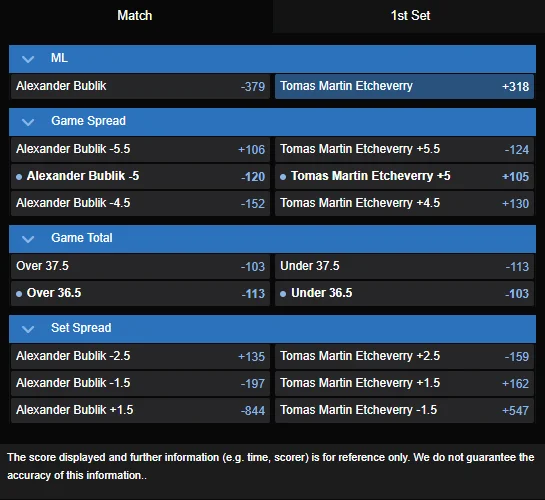
- Moneyline: Bublik is priced as a clear favorite, reflecting confidence in his serve driven edge on hard courts. The market acknowledges Etcheverry’s resilience but assigns limited probability to a full upset.
- Game Spread: The spread suggests expectations of separation through breaks rather than tiebreak heavy sets. Bublik’s ability to win service games quickly creates structural distance.
- Game Total: Totals in the mid to high 30s imply a four set projection rather than a drawn out five set battle. This aligns with Bublik’s efficiency.
- Set Spread: Bublik favored to cover a multi set margin reflects belief in his ability to secure three sets even if one set is dropped.
- Set Total: Under set totals are supported by the difficulty Etcheverry faces in sustaining pressure across extended formats.
Final Prediction
This matchup is dictated by surface fit and efficiency. Tomas Martin Etcheverry is capable of grinding through extended rallies, but Alexander Bublik’s serve and variety remove many of those opportunities before they develop.
Unless Bublik experiences prolonged lapses in focus, his ability to control service games and shorten points should consistently place Etcheverry under pressure.
For the Alexander Bublik vs Tomas Martin Etcheverry best odds, visit the best arbitrage sportsbook, where reduced juice can materially impact long term returns.
Bettor Summary
- Bublik path: Serve dominance, point shortening, variety.
- Etcheverry path: Extend rallies, exploit lapses, physical pressure.
- Market lean: Bublik moneyline and set spread.
- Live angle: If Bublik drops focus early, in play prices may offer value.
Disclaimer
This analysis uses AI assisted statistical research alongside human analysis and editorial oversight. Despite verification efforts, data errors may occur. Readers should independently verify odds, player stats, and records before betting. Projections are analytical estimates, not guarantees.