This reflects a scenario where Moutet creates stretches of disruption and steals momentum, but Zheng’s consistency and physical tolerance carry more weight as the match progresses.
Michael Zheng vs. Corentin Moutet Advanced Match Analysis – Australian Open Men’s Singles 2nd Round
Australian Open 2026: Michael Zheng vs. Corentin Moutet Advanced Match Analysis
Event: Australian Open 2026 – Men’s Singles
Date: January 20th, 2026
Round: Second Round
Surface: Outdoor Hard
Location: Melbourne Park
Most Likely Outcome
Zheng in four sets.
Matchup Snapshot
| Attribute | Michael Zheng | Corentin Moutet |
|---|---|---|
| ATP ranking range | Emerging tier | Established top 100 |
| Age | Young | Mid 20s |
| Primary strengths | Consistency, rally tolerance | Creativity, touch, disruption |
| Preferred match state | Structured and physical | Unstructured and reactive |
| Main risk | Handling variety | Emotional swings and patience |
At its core, this is a matchup between order and disruption. One player wants rhythm and repetition. The other thrives when patterns break down.
Matchup Profile
Michael Zheng enters this match with far less public familiarity, but his game is built around elements that translate well to Grand Slam tennis. He plays with margin, absorbs pace comfortably, and is willing to extend rallies until openings appear. His success is not tied to spectacular shotmaking but to staying solid point after point.
Corentin Moutet is the opposite. He is at his best when he can inject variety, break rhythm, and force opponents into uncomfortable decision making. Drop shots, sudden changes of pace, and unconventional patterns are not tricks for him but core parts of his identity as a player.
The tension in this matchup comes from how long Moutet can keep the match in that unstable space. If he succeeds, Zheng can be pulled into awkward positions and rushed decisions. If he fails, the match risks becoming physically demanding in a way that favors Zheng.
Player Context and Tournament Expectations
For Zheng, this match represents an opportunity to show that his game can hold up when the stage grows larger. Early rounds at a Slam often test players not with difficulty but with patience. Matches can turn into extended exchanges where discipline matters more than flair. Zheng’s profile fits that demand well.
Moutet arrives with a different set of expectations. He has experience on big courts and is comfortable being the more recognizable name in the matchup. That experience can help him manage moments of pressure, but it can also come with frustration when opponents refuse to engage on his terms.
Historically, players like Moutet tend to be at their best when they feel in control of the emotional tone of a match. When that control slips, focus and shot selection can follow.
Surface and Conditions Impact
Outdoor hard courts in Melbourne reward players who can stay balanced and defend wide areas of the court. Long rallies are common, especially when neither player is producing a high volume of free points on serve.
Zheng benefits from these conditions because his movement and shot tolerance allow him to stay patient without losing depth. He does not need to shorten points to feel comfortable, which helps him conserve energy over time.
Moutet’s variety can be effective here, but it comes at a cost. Drop shots and sudden changes of pace require precision. When timing is off or legs are heavy, those same shots can turn into liabilities rather than weapons.
Serve and Return Dynamics
Zheng on Serve
Zheng’s serve is functional rather than dominant. He uses placement and consistency to start points without giving away cheap errors. While he may not rack up aces, he also avoids the type of service games that spiral out of control.
Against a returner like Moutet, this steadiness matters. It forces Moutet to win points through construction rather than anticipation alone.
Moutet on Serve
Moutet’s serve is more about variety than power. He changes spins and speeds to disrupt timing, but this approach can also lead to inconsistency. When service games become complicated, frustration can creep in.
Extended service games often tell the story with Moutet. When he holds efficiently, he tends to stay engaged. When holds require constant scrambling, his focus can drift.
Rally Length and Point Construction
Rally dynamics favor Zheng when points stretch beyond the opening exchanges. He is comfortable resetting rallies and waiting for errors rather than forcing low percentage shots. His consistency allows him to absorb Moutet’s creativity without panicking.
Moutet can win spectacular points in longer rallies, but the question is sustainability. Over the course of a set, relying on creativity rather than structure becomes mentally demanding. If those shots stop landing, errors follow quickly.
This matchup often turns on whether Moutet’s variety feels inspired or forced.
Tactical Responsibilities
Zheng Game Plan
Zheng’s priorities are simple but demanding. He needs to stay disciplined, avoid chasing drop shots recklessly, and trust that consistency will pay off. By keeping rallies neutral and forcing Moutet to play extra balls, he increases the chance that frustration sets in.
Patience is his biggest weapon here.
Moutet Game Plan
Moutet needs to stay proactive without crossing into recklessness. His variety works best when it feels natural rather than desperate. Choosing the right moments to disrupt rhythm, rather than trying to do it on every point, will be critical.
Managing emotions is just as important as shot selection.
Match Flow and Momentum
This match is likely to swing more in momentum than many early round contests.
If Moutet finds rhythm early and begins dictating the tone, the match can become uncomfortable for Zheng. Quick shifts in pace and frequent changes in pattern can shorten points and prevent Zheng from settling.
If Zheng weathers that phase and keeps sets close, the dynamic can flip. As rallies lengthen and physical demands increase, the match becomes more predictable and less volatile.
Momentum here is often emotional rather than purely tactical.
Match Progression Over Time
| Stage | Typical pattern |
|---|---|
| Early phase | Moutet tests variety and rhythm |
| Middle phase | Rallies lengthen, errors surface |
| Late phase | Consistency and patience matter most |
As the match progresses, emotional control often matters as much as physical endurance.
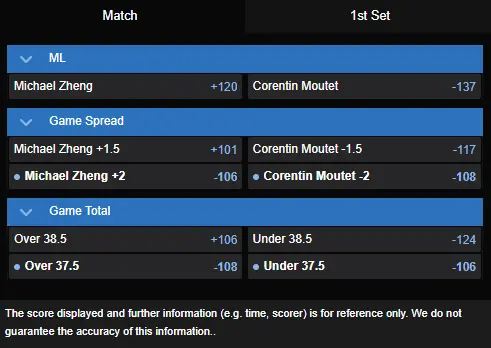
Market Odds Snapshot at bet105
-
Moneyline: Moutet being priced as a modest favorite reflects his experience and ability to disrupt play, but the relatively close gap suggests the market expects Zheng to be competitive rather than overmatched.
-
Game Spread: The tight spread indicates an expectation of closely contested sets, with Zheng’s consistency likely keeping games tight even if Moutet controls momentum at times.
-
Game Total: Totals set in the high 30s point toward a longer match with extended sets, which aligns with a scenario where neither player runs away early and at least four sets are in play.
bet105 Perspective
This is the type of matchup where markets can overreact to momentum swings. Moutet’s ability to create highlight moments can influence perception quickly, while Zheng’s steadiness may be undervalued because it looks less dramatic.
For bettors looking to approach this match through bet105, the focus should be on whether the match remains chaotic or gradually settles. That distinction tends to determine which player gains the upper hand as sets progress.
—
For the best odds on Michael Zheng vs. Corentin Moutet at the Australian Open 2026, visit bet105, the top arbitrage sportsbook with reduced juice, fast crypto payouts, and sharp friendly limits.
Disclaimer
This analysis uses AI assisted statistical research alongside human analysis and editorial oversight. Despite verification efforts, data errors may occur. Readers should independently verify odds, player stats, and match details before betting. This content is analytical in nature and does not guarantee outcomes.